Best Tips to Ace Job Assessment Tests in 2026/2027
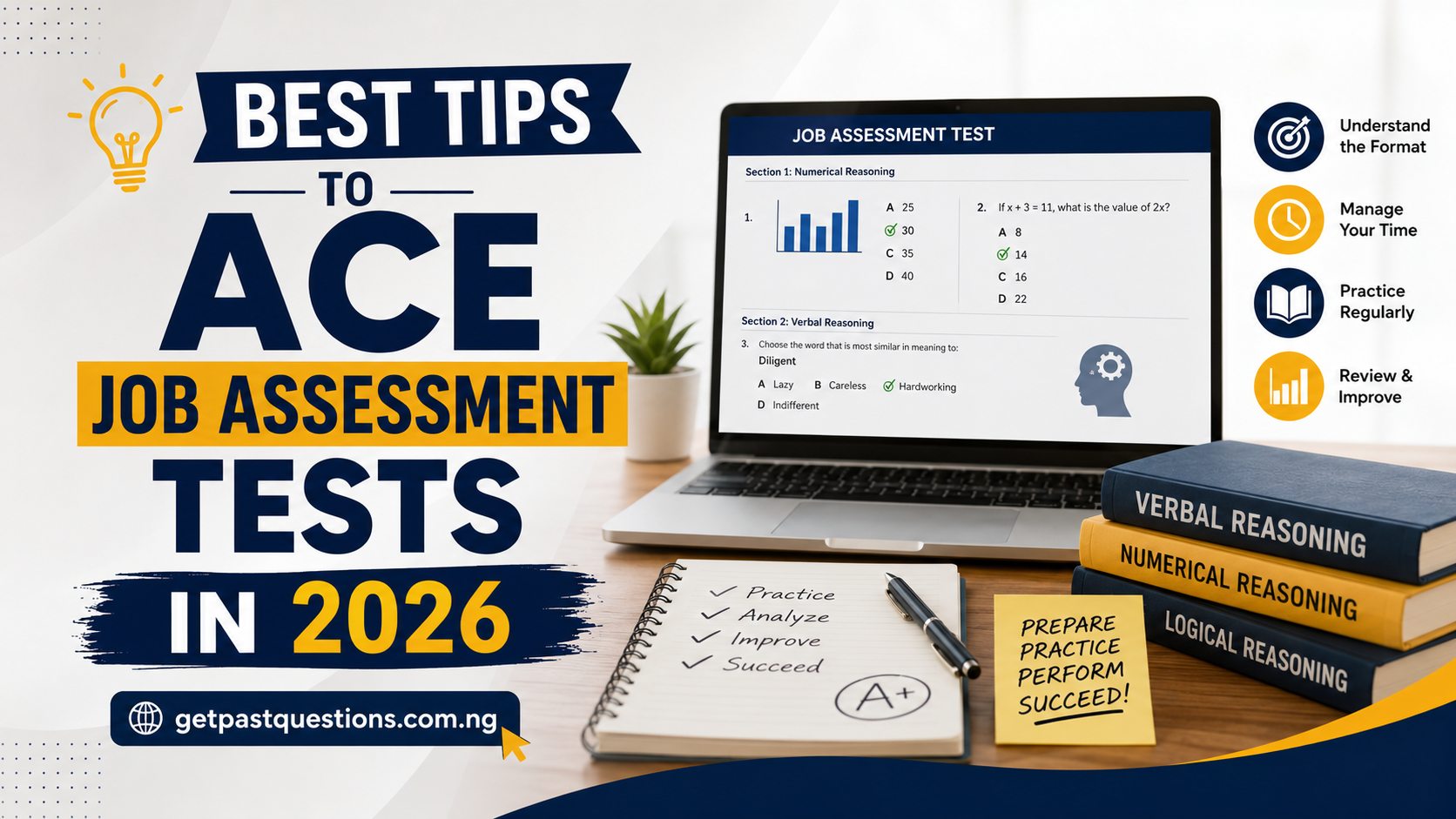
Best Tips to Ace Job Assessment Tests in 2026/2027: Most people have polished their CV, tailored your cover letter, and made it past the initial screening. Then comes the message every job seeker dreads just a little: “Please complete or take the following assessment before your interview.” Suddenly, all that careful preparation feels like it may not be enough.
Job assessment tests have become a standard part of the hiring process in 2026. Employers across industries from banking and tech to healthcare and NGOs use them to filter candidates objectively and identify who is truly ready for the role.
These tests evaluate everything from your cognitive ability and job knowledge to your personality traits and how you handle real workplace situations.
The good news is that assessment tests, like any test, can be prepared for. With the right approach, you can walk into yours whether online or in-person with confidence. Here are the best tips to help you do exactly that.
1. Understand What Type of Assessment You Are Facing
Before you prepare for anything, you need to know what you are preparing for. Job assessment tests are not all the same. Depending on the employer and the role, you could face any of the following:
- Aptitude or cognitive ability tests measure your numerical reasoning, verbal reasoning, logical thinking, and problem-solving speed. These are among the most common pre-employment assessments and are used by large organizations to evaluate raw intellectual potential.
- Skills-based tests assess your actual ability to do the job. For an administrative role, this might mean a typing speed test or a document formatting exercise. For a data role, it could involve working with spreadsheets or interpreting charts. For tech roles, expect coding challenges or debugging exercises.
- Situational judgement tests (SJTs) present you with hypothetical workplace scenarios and ask you to choose the most appropriate response. These test your professional judgment, communication style, and values.
- Personality assessments help employers determine whether your work style, motivations, and behavioral tendencies are a good fit for their team and culture. These are not tests you can technically pass or fail, but they significantly influence hiring decisions.
- Job knowledge tests evaluate your expertise in a specific field legal knowledge for a paralegal role, public health principles for an NGO position, or financial management for a finance role.
Knowing which or what type of test you will face allows you to tailor your preparation instead of spending valuable time studying the wrong things.
When you receive your interview invitation, do not hesitate to ask what kind of assessment will be involved. Most employers are willing to share this information.
2. Research the Employer and the Role Thoroughly
Assessment tests are not generic. They are designed to reflect the specific competencies the employer values and the real demands of the role. This means understanding the organization deeply gives you a significant advantage.
Study the company’s mission, values, and culture. Read through the job description multiple times and pay close attention to the keyword’s words like “analytical,” “collaborative,” “client-facing,” or “detail-oriented” are signals of what the employer is testing for.
If the job description emphasizes leadership and initiative, expect behavioral questions around those themes. If it stresses accuracy and compliance, expect detail-oriented tasks and scenarios.
Look for reviews from former applicants on platforms like Glassdoor or LinkedIn. Many candidates share insights about what to expect during the hiring process, including the types of assessments used. This kind of insider knowledge is invaluable and completely accessible if you take the time to look.
3. Practice with Real Sample Tests
There is no substitute for practice especially under conditions that mirror the actual test. Most aptitude and skills-based assessments are timed, which means knowing the material is only half the challenge. You also need to know how to work through it quickly and accurately under pressure.
4. Take the Personality Assessment Honestly
Many candidates make the mistake of trying to game personality assessments answering questions the way they think the employer wants, rather than honestly. This approach almost always backfires.
Modern personality tests are designed with built-in consistency checks. If your answers contradict each other, the system flags it. Beyond that, even if you manage to present a false profile, you may end up being selected for a role that is a poor fit for your actual work style which rarely ends well for anyone.
The better strategy is to be yourself while putting your best foot forward. Think about what the role genuinely requires and answer in a way that reflects how you would actually show up in a professional context. Most employers are not looking for a single “correct” personality type they are looking for alignment between your natural tendencies and the demands of the role.
Answer thoughtfully, avoid extremes where they do not reflect you accurately, and trust that authenticity gives you the best foundation for a job that will actually suit you.
5. Manage Your Time Strategically During the Test
Time pressure is one of the biggest challenges in job assessment tests, particularly aptitude exams. Many candidates know the answers but run out of time before completing the test, which drags their score down significantly.
Going in with a time management strategy prevents this. Before you start, get a sense of how many questions there are and how much time you have. Divide accordingly. If a section has 30 questions and 20 minutes, you have roughly 40 seconds per question so you know that spending three minutes on a single difficult question is not an option.
Develop a “skip and return” habit. If a question is taking too long, mark it and move on. Spending disproportionate time on hard questions while leaving easy ones unanswered is one of the costliest mistakes you can make. Always prioritize completing the full test over perfecting individual answers.
Read every question carefully before answering. This sounds obvious, but many candidates misread questions under time pressure and choose wrong answers they would have gotten right if they had taken an extra five seconds to read properly. That small discipline can make a noticeable difference in your score.
6. Set Up the Right Environment for Online Assessments
In 2026, the majority of job assessment tests are taken online often from home. This introduces a whole set of environmental factors that can either help or hurt your performance.
Choose a quiet space where you will not be interrupted. Inform the people around you that you need uninterrupted time for the duration of the test. Silence your phone notifications and close any browser tabs that are not related to the assessment.
7. Prepare Your Mind and Body for Peak Performance
No strategy works at its full potential if the person executing it is exhausted, stressed, or distracted. Mental and physical readiness are not afterthoughts they are part of your preparation.
Get a full night of sleep before your assessment. Research consistently shows that sleep deprivation reduces cognitive function, slows processing speed, and impairs working memory all of which are tested in aptitude assessments. No last-minute cramming is worth sacrificing your sleep for.
8. Follow Up After the Assessment
Once you have completed the test, do not go quiet. If you do not hear back within the timeframe the employer mentioned, it is appropriate to follow up professionally. A brief, polite email expressing continued interest and asking about next steps shows initiative and keeps you visible.
If you do not advance to the next stage, do not be discouraged. Many employers in 2026 now provide assessment feedback to unsuccessful candidates. Politely requesting this feedback gives you specific, actionable information about where to improve making you stronger for the next opportunity.
Every assessment you take, pass or not, builds your test-taking experience. The candidates who succeed consistently are not always the most naturally gifted. They are the ones who learned from every attempt and kept showing up prepared.
Final Thoughts
Job assessment tests in 2026 are no longer a formality they are a critical filter in the hiring process. But they are also one of the most level playing fields in recruitment. Unlike interviews, where nerves and first impressions can distort the outcome, a well-prepared candidate can genuinely outperform competitors regardless of connections or background.
Know your test. Research the employer. Practice deliberately. Be honest in personality assessments. Manage your time wisely. Set up a strong test environment. And show up rested and ready.