
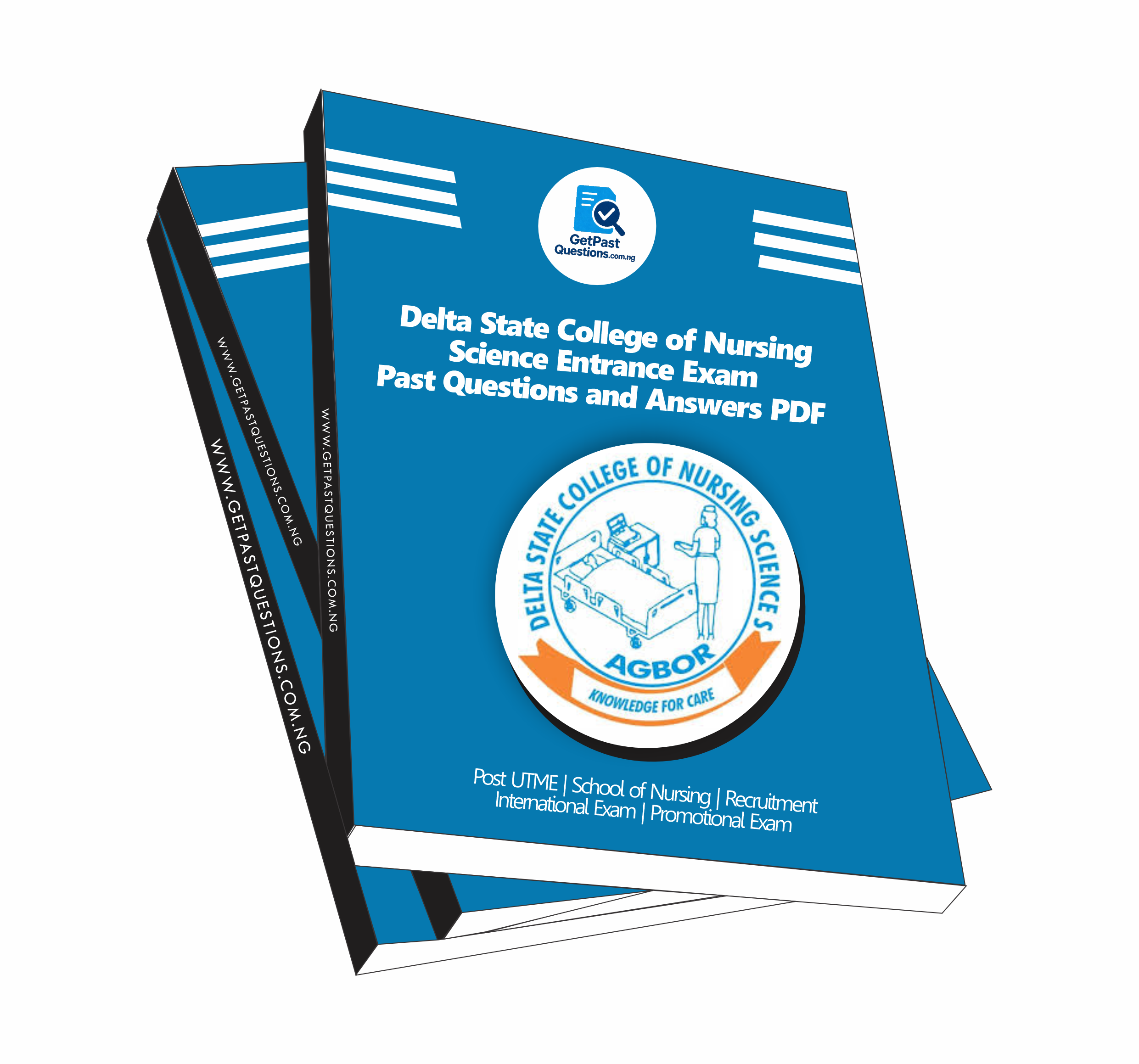
Delta State College of Nursing Science Past Questions & Answers 2026 Updated
Original price was: ₦5,000.00.₦3,000.00Current price is: ₦3,000.00.
Download and practice the Delta State College of Nursing Science Past Questions and Answers PDF (2021 to 2025) to facilitate adequate preparation for the upcoming entrance examination in 2026.
The 2026 updated version of the Delta State College of Nursing Science past questions & answers will foster your preparation for the entrance examination by unveiling the subject combination for the forthcoming exam, question pattern, topics that mostly repeat, number of questions to expect and other important information.
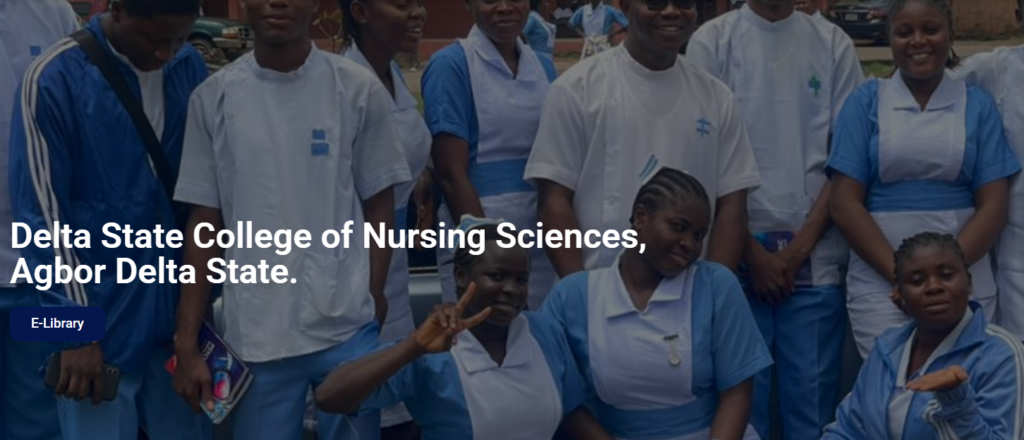
The Delta State College of Nursing Sciences, Agbor (DSCNSA) as approved by the Nursing and Midwifery Council of Nigeria (NMCN) was established in 1981. After full accreditation, academic activities resumed on June 30, 1987.
The core mission of this institution is to train nurses with up-to-date resources and frameworks that helps them gained necessary knowledge, exposure and excellence in healthcare.
It is one of the widely recognized and sort after school of nursing, as such, the admission competition is really high. Sequel to the high competition, you must prepare adequately and the Delta College of nursing science past question got you covered.
Whether this is your first time attempting this exam or not, we’ve got nothing to worry about.
Features of DSCNSA Past Questions
The Delta State College of Nursing Sciences, Abgor past questions focuses on the entrance examination, as such it covers:
- English Language
- Biology
- Chemistry
- Physics and
- General Knowledge etc.
Note: The past questions is neatly arranged and compiled into a Portable Document Format (PDF) which makes it easy to study/practice with your mobile phone, iPad, Laptop or better still print the hard copy out.
How to Download Delta State College of Nursing Science Past Questions
To get a copy of the Delta State College of Nursing Science Past Questions and Answers PDF (2021 – 2025), scroll to the top of this page, click the “get past questions” button, fill out the form, complete payment and then you can download the material. If you face any challenge, feel free to call the number on your screen or send us a WhatsApp message.
Related Past Questions:
- Ogun State College of Nursing Past Questions and Answers (2014 – 2025)
- LUTH College of Nursing Science Past Questions and Answers PDF (6 Years)
- FCT College of Nursing Past Questions and Answers PDF (2021 – 2026)
Positive Outcome of Studying DSCNSA Past Questions
- Familiarity with Exam Pattern: One of the primary things you will note are the subjects you will write in the entrance exam, number of questions each subject contains, topics that are mostly covered and what the exam generally looks like.
- Eliminates Anxiety: Through the continuous practice of this material, you will gain more confidence, come better at answering questions and this help eradicate the fear of passing the examination to a large extent.
- Repetition of Questions: This cannot be overemphasized, because as you study / practice the past questions year by year, you will see that some topics and even questions directly or indirectly repeat.
- Better Chance of Passing: Past questions makes your study process a little easier, and with the above benefits you have a strong advantage over other candidates. This will result in scoring high and thereby appearing on the merit list.
Sample of Delta State College of Nursing Science Past Questions
Below is an except from the full past questions, if you need the complete material, then click the “get past questions“ button at the start of this page and follow the instructions thereof.
DSCNSA SQ refers to Delta State College of Nursing Sciences Sample Questions.
DSCNSA SQ 1: Let’s say a nurse lifts a patient weighing 600 N to a vertical height of 0.5 m. What is the amount of work completed?
- A) 150 J
- B) 300 J
- C) 600 J
- D) 1200 J
The right response is B) 300 J since work is equal to force × distance. Consequently, W = 600 N × 0.5 m = 300 J. Recall that when a force pushes an object a certain distance in the force’s direction, work is completed.
DSCNSA SQ 2: What is the term for the electromagnetic radiation typically utilized in hospitals for X-ray imaging?
- A) Gamma rays
- B) UV radiation
- C) X-rays
D) Rays of infrared
The right response is C) X-rays since they are easily penetrated and have wavelengths of 0.01 and 10 nanometers.
DSCNSA SQ 3: The normal body temperature of an adult is 37 degrees Celsius. We need to find out what this temperature is in Kelvin.
- A) 236 Kelvin
- B) 273 Kelvin
- C) 300 Kelvin
- D) 310 Kelvin
The correct answer is D) 310 Kelvin. To get the Kelvin value we have to add 273 to the Celsius temperature.
So we do this: 37 degrees Celsius plus 273 equals 310 Kelvin. The Kelvin scale is what we use to measure temperature. The Kelvin scale is the unit we use for temperature in science. We use the Kelvin scale to measure the temperature of things. The normal body temperature of an adult, in Kelvin is 310 Kelvin.
DSCNSA SQ 4: Imagine a syringe is being used at X hospital. It pushes with a force of 10 N on an area of 0.002 m². How pressure does the syringe apply to that area?
- A) 200 Pa
- B) 500 Pa
- C) 2,000 Pa
- D) 5,000 Pa
The correct answer is D) 5,000 Pa. To ascertain this, pressure is calculated by dividing the force by the area. So we do the math: pressure equals 10 divided by 0.002, which equals 5,000 Pa. Understanding pressure is really important for nurses. They need to know about it for things like how fast IV drips should go, reading blood pressure and taking care of wounds. The pressure concept is crucial in nursing, for these things.
DSCNSA SQ 5: What is the main job of blood cells?
- A) Fight off infections
- B) Carry oxygen and carbon dioxide
- C) Make antibodies
- D) Help blood clot
Correct Answer: B) Carry oxygen and carbon dioxide
Red blood cells have a role. They contain haemoglobin. This helps pick up oxygen in the lungs. Then it releases oxygen to tissues, in the body. These cells do not have a nucleus. This gives room for haemoglobin. If someone lacks iron they can get anaemia. This is because their red blood cells cannot carry oxygen properly.
DSCNSA SQ 6: Which part of the human brain controls actions like heartbeat and breathing that happen on their own?
- A) Cerebrum
- B) Cerebellum
- C) Medulla oblongata
- D) Hypothalamus
Correct Answer: C) Medulla oblongata
The medulla oblongata’s in the brainstem. It helps control things like heart rate and breathing. The medulla oblongata also helps with blood pressure. It even helps with actions, like swallowing and vomiting. These are things our body does on its own. The medulla oblongata helps make it all happen.
DSCNSA SQ 7: According to science how chambers does the human heart have?
- A) 2
- B) 3
- C) 4
- D) 5
The correct answer is C) 4.
The human heart has four chambers. It has an atrium and a right ventricle.
The heart also has an atrium and a left ventricle. The right side of the heart pumps blood to the lungs. This blood is not oxygen-rich. The left side pumps blood to the rest of the body. This blood is oxygen-rich. So the human heart has 4 chambers.
DSCNSA SQ 8: Cells use respiration to produce energy from glucose when oxygen is available.
- A) Photosynthesis
- B) Anaerobic respiration
- C) Fermentation
- D) Aerobic respiration
Correct Answer: D) Aerobic respiration
Aerobic respiration is when cells make energy from glucose using oxygen. It happens in the mitochondria. Makes about 36 to 38 ATP molecules from one glucose molecule. This is much better than respiration. The equation, for respiration is: C₆H₁₂O₆ + 6O₂ → 6CO₂ + 6H₂O + ATP.
DSCNSA SQ 9: What war made Florence Nightingale really famous for the work she did as a nurse?
- A) World War I
- B) The American Civil War
- C) The Boer War
- D) The Crimean War
Correct Answer: D) The Crimean War.
Florence Nightingale was in charge of nurses at Scutari, which’s now part of Turkey during The Crimean War from 1853 to 1856. She did a job of reducing the number of people who died by making sure everything was clean. Florence Nightingale also started using pictures and graphs to show information about healthcare, which was an idea, at the time. The Crimean War is what really made Florence Nightingale famous for her nursing work.
DSCNSA SQ 10: What does the acronym AIDS refer to?
- A) Acquired Immune Disorder Syndrome
- B) Active Immunodeficiency Disease Syndrome
- C) Acquired Immunodeficiency Syndrome
- D) Acute Infectious Disease Syndrome
Correct Answer: C) Acquired Immunodeficiency Syndrome.
AIDS is caused by a virus called HIV. This virus destroys some cells in our body that help us fight infections. As a result our immune system gets weaker. The term “Acquired” means we are not born with it. It also means that we get it from else. The word “Immunodeficiency” simply means our immune system is weakened. Lastly “Syndrome” refers to a group of health problems that occur together.
AIDS is a syndrome because it has related health issues. The AIDS virus. Destroys CD4+ T-cells. These cells play a role in helping our body fight infections. Without them we become more prone to getting sick. That is why people, with AIDS get very sick easily.
Have you registered yet for the entrance examination? If now, visit the DSCNSA registration portal to do so.
1 review for Delta State College of Nursing Science Past Questions & Answers 2026 Updated
Related products
-
Sale!
Abia State School of Nursing Past Questions & Answers 2022 to 2026 PDF
Original price was: ₦5,000.00.₦3,000.00Current price is: ₦3,000.00. -
Sale!
College of Nursing Ilaro Past Questions PDF Download (2014 to 2025)
Original price was: ₦5,000.00.₦3,000.00Current price is: ₦3,000.00. -
Sale!
College of Nursing Sciences Tambuwal Past Questions and Answers (2020 – 2026)
Original price was: ₦5,000.00.₦3,000.00Current price is: ₦3,000.00.
Temitope olorundamilola –
I love and i wish to be there soon